By Debbie Patryn
Fall in Southwick, Massachusetts, can be especially beautiful for hiking. The air is crisp and cool, and colorful leaves drift gently to the ground. When my family finished our summer camping season, we were eager to get outdoors whenever we could to enjoy the fall weather.
One sunny, cool fall Sunday, we decided to hike Mount Tekoa in nearby Westfield. Finding the parking lot at the start of the trail was a bit tricky, but after several wrong turns, we finally located it. This was long before Google Maps! Our daughters, Julie, 6, and Amy, 4, were eager to get going, so off we went with lunch packed in a backpack and little else.
The trail up the mountain was steep, with many turns, usually marked by signs pointing the way. Julie stayed with her dad, Jim, while Amy walked with me. When we reached the top, we were rewarded with panoramic views of the Westfield River Valley, beautiful with its fall colors. After eating lunch, we packed up our trash (leave no trace!) and started down.
That was when the trouble began.
Jim and Julie headed down the trail ahead of Amy and me and quick-ly disappeared from sight. When Amy and I reached the first inter-section, we weren’t sure which way to go.
“Jim? Julie? Where are you?” I called.
No response. So I guessed which way to go, grabbed Amy’s hand, and started off again. After several min-utes, we came to another intersection.
“Jim? Julie?”
Silence! Now which way? Still clinging to Amy’s hand, I started off again. Another inter-section, more calling, and more silence! I was beginning to worry that Amy and I were truly lost. Down we headed, calling as we went, but still no answer.
Finally, after a very long 30 minutes, Amy and I found the parking lot. Whew! But wait—no Jim or Julie in sight. Where were they?
We waited in the parking lot for at least 20 minutes before we finally saw them emerge from the woods. Turns out Jim had climbed up and down that mountain three times with Julie, looking for us!
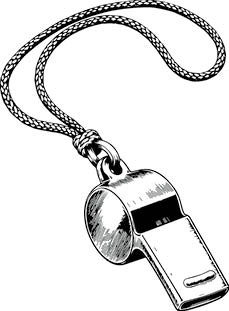
We learned two important lessons that day. First, Jim needed to keep Debbie in sight at all times. (She gets lost easily!) Second, on every hike from then on, we all carried whistles and had a special tweet to use if we got separated.
Jim has since passed away, and Julie and Amy are grown, with children of their own. But 35 years later, I still go hiking, especially in the fall.
And I still carry that whistle.











INDEX
By Bernadette Gentry
Crisp, cool air,
brilliantly colored leaves,
sweater and sweatshirt weather.
Fall football games,
hayrides, fire pits glowing,
fun and laughter for all.
Halloween costumes,
candy galore,
pumpkins and parties—
a magical night!
We rake the leaves,
the darkening comes,
we go inside.
Goodbye, oh month of beauty!
Goodbye, oh glorious days!
We will miss you so . . .







October 2015

October 1, Monday. I left Greenfield be-hind a 14-car funeral procession, which prayer guided me to bypass by taking route through Whately so that I came back onto Route 5 in Northampton just ahead of the leading car. Left things for parties in Springfield. Got gas, grocer-ies, and home. Hung door on woodshed. Started pump to fill wellhouse reservoir and took baby to watch trucks dumping fill at new bridge. Took Elizabeth and baby to ride up Norwich Hill and to Knightville dam. Foliage is golden. Told baby leaves turned gold for “golden boy.”
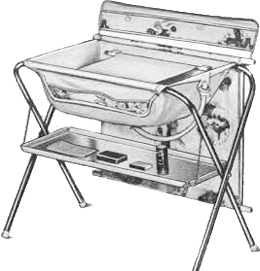
October 2, Tuesday. To laundry 5:30-6:30 a.m. When I stood baby on bathinette he put both hands on my cheeks and said, “Shave.” Elizabeth’s mother has the grippe.
October 3, Wednesday. I forgot jacket in Springfield office and had to go back for it from A&P. Got groceries at Roberts and saw Ginny At-water starting work. When I mentioned mother A’s illness she said MR. A talked as if she were dying and got on Ginny’s nerves.
October 4, Thursday. Home on vacation p.m. Did washing. Sawed wood till 7:30 p.m.
October 5, Friday. Got groceries and home 5:45 p.m. Elizabeth had power failure this a.m. Lights are back now but started dimming and flickering again. Montgomery is having other electric troubles. Lester and Mabel came. She is planning open house for Uncle Ralph’s and Aunt Georgia’s 50th anniversary.
October 6, Saturday. Charles Manley fixed loose connection where wires from street at-tach to house. Huntington Hardware was very busy. A sour young man in black Levis and T shirt spoke ahead of others for nine flash light batteries. He was put out at having to wait. Two boys with him had tried unsuccessfully to get the New York Times in town. I heard him say that it was too bad to have to go all the way to Westfield to get the New York Times. After I’d been across the street to the Market Basket for groceries, Mr. Pero found me the ring washer I needed. I also got batteries. Home 11:45 a.m. Baby was napping. Uncle Ralph came at noon. Took him to ride by Littleville dam construction and up Clark Wright Road stopping at Glendale Falls, then over mountain and home through Chester. After Uncle Ralph left I turned off wa-ter to repair kitchen faucet. Poor flow was most-ly due to clogged strainer.
October 7, Sunday. Did washing at Russell laundry. Took mother Hester to church by way of home to get umbrella. John Camp sings bass in choir very well.
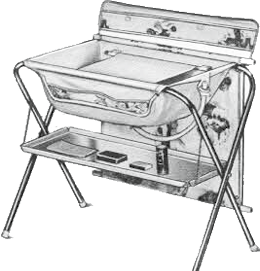
October 8, Monday. At Greenfield office I found supervisor George Berry on vacation. At O. B. Parks I made down payment of $139.95 for a snow blower. I raked leaves and Elizabeth got permit from Lucy Hall to burn them. I took baby on my shoulders up to mountain mead-ow where Stella Williston, her brother, Harlow Clark and daughter, Mae Smith, were mending fences. Stella says her grandson is afraid of the cows. Atwaters came and played outdoors with baby while I raked leaves and sawed wood. Af-ter supper I read to E, then played records for baby while she washed floor.
October 9, Tuesday. Well water is 2 feet deep. On way home I parked at library and walked across green to post office. Met Lillian Cowles. She told me her mother, Grace, died this morn-ing. I offered to help with funeral Thursday at 10 a.m. Ordered flowers from Flower Shop. 7:30 phoned Sue Allyn to tell her I will help with Cowles funeral.
October 11, Thursday. 9:30 a.m. To Grace Cowles funeral and Montgomery cemetery as pall bearer. Sue brought Hester and me back to Westfield by 1:30. Visited parties in Agawam. Home by 5:00 p.m. Went right to laundry with big wash. Home by 6:30 with headache.
October 12, Friday. Laundry 8:00-9:30. Saw Mel Avery on Noble St. and told him I will need him to take down more trees. I disconnected pump and brought it up from brook. Piston had punched hole in side of motor. I tried to get mo-tor apart but didn’t have the right tools.
October 13, Saturday. Well water is two feet deep. To laundry 6:00-7:00 a.m. To Westfield to get car lubricated, picked up baby things at Sears and got groceries. Home 11:30 a.m. Atwa-ters came. Grandson, Jim broke neighbor’s win-dow playing football with friend when he was supposed to stay in house with sister Pam while parents were away at hockey game. I prayed God to tell if there was anything wrong in the book, The Boy and the Brothers. Answer was, “Yes” Kundalini was one thing but there was something else.
October 14, Sunday. I brought Hester to church by way of East Mountain Road and Hampton Ponds. Marian Avery arrived to sing with choir despite telephone refusal, she took her moth-er, Mrs. Dinsmore, to Springfield to catch the train for Florida. Marian thinks people don’t like Dr. Teale and that Mrs. Leonard and Mrs. Royle are trying to make everything strictly Congrega-tional. Hester came home to dinner with me. When baby woke from nap I carried him over to field where Mrs. Peckham was digging pota-toes. She brought us some. We met Nancy Peck-ham on her horse. I made four trips to brook for water.
October 15, Monday. Atwaters visited and brought us supper. Made three more trips for water.
October 18, Thursday. At noon Sears had motor mounted and ready, $16.83. Mel Avery came to take down ashes and butternut trees, maple and dead elm on town road property for total of $175. He will get all the logs tomorrow.
October 20, Saturday. Baby played hide and seek with Mr. Bundy, his toy rabbit beside me while I did ironing . He can say “umbrella” and answer questions such as “What does the bird say?’ In Westfield I added quart of Prestone to radiator at Post Office Service Station. At Sar-ah Gillett Home showed Hester new movie of “Little Boy in Brook,” and played piano for her, Mrs. Weed and Mrs. Jordan. When baby woke from nap I took him up to Williston’s pasture and Stella took us to barn to see new calves and kittens. At home Atwaters visited and brought baby a rocking horse which I put together. Saw smoke back of Dotty’s house on railroad. Looked for Paul. Found him on tracks in Russell. He had just put out two fires. His father was out looking for more trouble.
October 21, Sunday. Took Hester to church where she and John Camp sang with choir. Dr. Teale’s sermon was better than usual. Disagree-ment brews between Community Church and Congregationalism. Got permit and burned a lot of fallen leaves. I took Hester home at 6:30 p.m. Baby went for ride and saw his first west-bound passenger train.
October 22, Monday. Sawed wood. After nap took Baby to walk up through woods and down past wellhouse reservoir where he said “water.” It pleased nurse Jean Watson to hear him say “catalog” and startled Elizabeth to hear him say “constipated.” There are at least 119 words that baby knows.
October 26, Friday. I left card and $5 for Uncle Ralph’s 50th anniversary. He says he’ll be glad when party is over.
October 27, Saturday. I took old dish pan to Dotty Barnes for her party’s apple dunking to-night. Turned clocks back.
October 28, Sunday. Gusty winds. On way to church through Wyben I got apples and little pumpkin for baby at Hartley’s. A tree was blown down across Franklin Street. I took Elizabeth to Ginny Atwaters for joint birthday party for her mother and Ginny’s mother, Mrs Davis. To bed with hot water bottle. Chest is full of wheezes which E calls rales.
October 31, Wednesday, At book fair in Court Square I got Twice Fifty Five Songs 5 cents and Cortina Spanish 10 cents to give library.
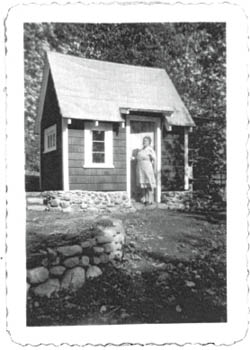
October 1962
By Clifton (Jerry) Noble Sr.
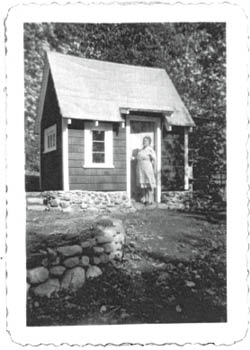
Hester at newly constructed
Well House, 1950s













By Dave Roberts
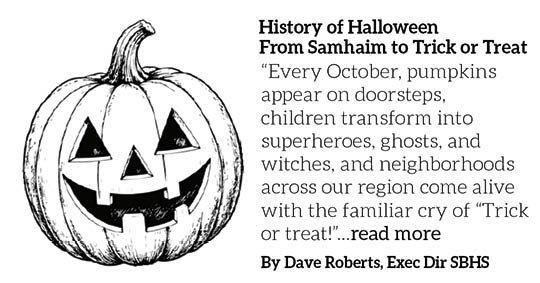
Every October, pumpkins appear on door-steps, children transform into superheroes, ghosts, and witches, and neighborhoods across our region come alive with the familiar cry of “Trick or treat!” Halloween seems like an American tradition as old as Thanksgiving or the Fourth of July. In reality, the holiday has a long and fascinating history—one whose roots are often traced back more than 2,000 years and whose customs crossed cultures and continents before reaching Connecticut and Massachusetts.
Halloween’s earliest roots are commonly linked to Samhain, an ancient Celtic festival marking the end of the harvest and the begin-ning of winter. Observed around Nov. 1, Sam-hain was associated with the belief that the boundary between the living and the dead be-came less distinct. According to later traditions, bonfires, disguises, and other customs offered protection from wandering spirits.
As Christianity spread throughout Europe, older seasonal traditions became intertwined with Christian observances. Nov. 1 became All Saints’ Day, or All Hallows’ Day, and the eve-ning before was known as All Hallows’ Eve. Over time, that name evolved into Halloween. Nov. 2 became All Souls’ Day, a day for remem-bering the dead.
Several Halloween traditions have interest-ing origins of their own. In Ireland and Scotland, people practiced forms of “guising,” dressing in costumes and going from house to house, sometimes offering songs or performances in exchange for food or treats. In England, “soul-ing” involved people visiting homes and receiv-ing food in exchange for prayers for deceased family members. These customs helped shape what eventually became trick-or-treating.
Even the jack-o’-lantern has an Irish begin-ning. Instead of pumpkins, which are native to the Americas, people carved frightening faces into turnips and placed lights inside them. When Irish immigrants came to the United States, they found pumpkins plentiful and easier to carve. The pumpkin jack-o’-lantern soon became an American Halloween icon.
Halloween customs spread more widely in America dur-ing the 19th century, par-ticularly with Irish and Scottish immigration. Early celebrations, how-ever, were not necessar-ily the family-friendly events we know today. During the 19th and early 20th centuries, Halloween was often associated with pranks and mischief. Young people might move objects, soap windows, overturn barrels, or find other ways to cause a little nighttime trouble. As some pranks grew destructive, communities be-gan looking for ways to make the holiday safer and more organized.
The modern American version of Hallow-een took shape during the 20th century. By the 1920s, the phrase “trick or treat” was appearing in North American newspapers. After World War II, the custom expanded dramatically. The end of wartime sugar rationing, the growth of suburban neighborhoods, and the availability of individually wrapped candy all helped make door-to-door trick-or-treating a centerpiece of the holiday.
So, what about Halloween here in Granby, Connecticut?
Unfortunately, the surviving local historical record does not provide a complete year-by-year account of how Granby residents celebrated Halloween in the 19th and early 20th centuries. That is one of the challenges—and pleasures—of local history. We often piece together the story from photographs, newspapers, town re-cords, family memories, and artifacts.
Still, Granby’s rural character, farms, and his-toric homes offer a fitting setting for Halloween traditions. Before elaborate store-bought cos-tumes and decorations became common, cele-brations often depended on imagination, home-made costumes, carved pumpkins, and a little good-natured mischief.
Today, Halloween in Granby continues to evolve. Local organizations provide children and families with opportunities to celebrate together. In recent years, trunk-or-treat events have been held at Salmon Brook Park and a lo-cal church, while community groups and busi-nesses have offered Halloween activities, sto-rytelling, costume events, and other seasonal programs.
Halloween also gives us a chance to connect with Granby’s history. The Salmon Brook His-torical Society’s mission is not simply to pre-serve old buildings and artifacts, but to share the stories of the people who lived here. Our community’s history includes celebrations, tra-ditions, superstitions, and stories passed from one generation to the next.
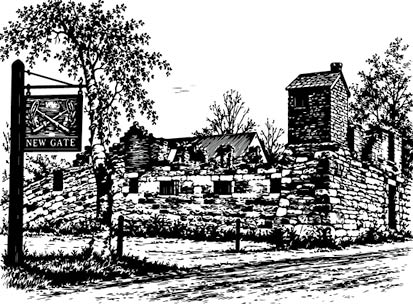
Granby has plenty of places to inspire a Halloween historian. Nearby Old New-Gate Prison and Copper Mine in East Granby have a particularly dark and fascinating past. The site has hosted Halloween programs featur-ing historical reenactors, along with seasonal jack-o’-lantern displays. Closer to home, the Salmon Brook Historical Society’s new Historic Gravestone Interpretive Display offers another opportunity to explore traditions surrounding death and remembrance. The display highlights historic gravestones and the people whose lives helped shape our community.
Perhaps that is what makes Halloween so en-during. Beneath the candy, costumes, and deco-rations is a much older human tradition: telling stories about the unknown, remembering those who came before us, celebrating the changing seasons, and gathering together as a commu-nity.
For centuries, people have found reasons to light a fire, put on a disguise, and tell a spooky story as the days grow shorter.
Here in Granby, we are continuing that tradi-tion.
And if you happen to hear a knock on your door this Halloween, remember—you are tak-ing part in a celebration whose roots reach back centuries, across oceans and cultures, to people gathering at the edge of winter and telling sto-ries about the world beyond our own.
So carve your pumpkin, turn on the porch light, and keep some candy handy.
Happy Halloween!.
History of
Halloween

From Samhaim to Trick or Treat










Lessons in
Hiking






Back to Index
Back to Index
Back to Index
By Todd Shiveley
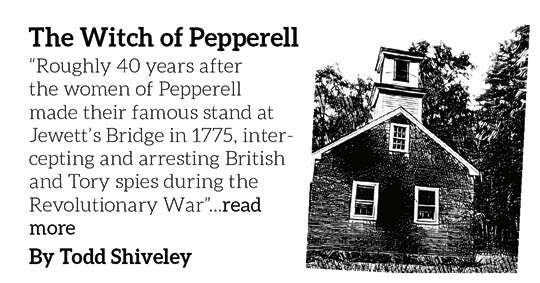
Roughly 40 years after the women of Pepper-ell made their famous stand at Jewett’s Bridge in 1775, in-tercepting and ar-resting British and Tory spies during the Revolutionary War, and shortly after the War of 1812, another strange story began to unfold in North Pepperell, Mas-sachusetts.
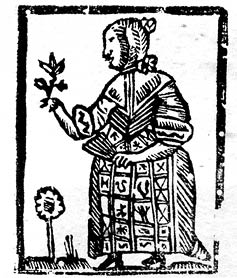
A lone woman, apparently widowed, known as “Miss Love Joy”, appeared in the small vil-lage. Although the days of Puritan rule were two decades ago, suspicions about witchcraft had not entirely disappeared. Miss Love Joy was an unusual sight, wearing a strange hand-kerchief over her head, allowing her pigs and cows to roam freely onto neighboring proper-ties, and making her home in a poor stone cabin beside a swamp.
The townsfolk of North Pepperell apparently had enough and like some strange 19th cen-tury bounty they went to remove her. Accord-ing to the legend, three men, acting with court approval, forcibly removed Miss Love Joy from her cabin. They branded her forehead with a hot iron, marking her as a witch and warning her that she was no longer welcome.
Lest she awak-ened, cursing the men and the entire village:
“This village will die! Flames will devour your businesses, and the rivers will wither and dry, and every house will crumble and die!”
With that, she fled into the woods, never to be heard from again. But it wasn’t long before the curse supposedly began to take hold.
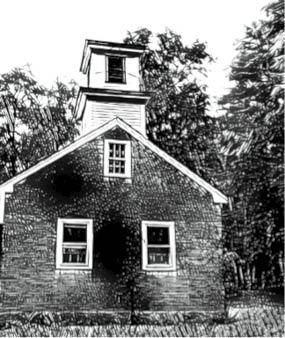
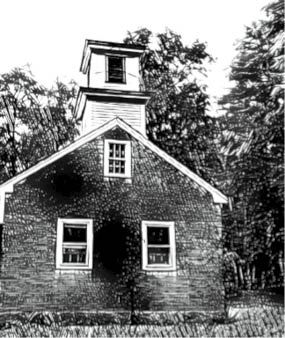
North Pepperell was a small but industrious village, consisting of a blacksmith shop, a store, a little red-brick schoolhouse, and several mills, including a gristmill, sawmill, and cloth mill, powered by the nearby Nissitissit River.
First, the gristmill burned down. Accidents happen, of course. Then the sawmill burned, the very mill that supplied lumber for rebuild-ing. After that, the last two more mills were de-stroyed by fire. By around 1840, all four mills had been rebuilt, only to burn down once again!
Then the dam burst, lowering the river’s wa-ter level until it could no longer provide suffi-cient power for the mills.
Now, one might explain the mysterious fires by imagining a haggard old woman lurking about, setting them herself. But how could any-one explain the strange deaths that followed?
A 4-year-old boy drowned in the river. A man fell from his wagon. An elderly gentleman broke his neck when his chair tipped over, while a respected member of the community choked to death in front of his own family.
Alas, accident after accident, tragedy after tragedy, the village slowly dwindled as fami-lies packed their belongings and moved away. By around 1910, only two sisters remained in North Pepperell.
Then came one final fire.
Both sisters rushed to help extinguish the flames. One died in the fire, while the other later suc-cumbed to her in-juries. The witch’s curse, it seemed, had finally been fulfilled. The once-busy village of North Pepperell was no more. The witches curse was complete.
A woman named Florence Sibley, of Pepper-ell proper, wrote an account titled “The Witch’s Prophecy” for a local Daughters of the Ameri-can Revolution meeting. In another eerie twist to the story, Sibley herself is said to have died alone, from starvation, in 1920.
More than a century later, Pepperell librar-ian Tina McEvoy located a handwritten copy of Sibley’s 1910 account titled “Witch Prophecy”, which was subsequently shared online. This provided a historical written source for the old legend.
Naturally, after first hearing this strange tale, I added North Pepperell to the list of places my two fellow New England folklore explorers and I wanted to visit. In October 2023—October, of course!—we finally made the trip.
We reached the general outskirts of the for-mer village, found the old schoolhouse, and proceeded along a trail into the woods, search-ing for cellar holes and remnants of the long-forgotten community.
But we hadn’t been walking for even 15 min-utes when the worst swarm of gnats and mos-quitoes imaginable descended upon us like a plague of locusts! Nothing could discourage them, not even the insect repellent we had al-ready generously sprayed on ourselves.
We had no choice but to turn back, swearing that our next visit would take place in much colder temperatures.
Happy All Hallows’ Eve, 2026!

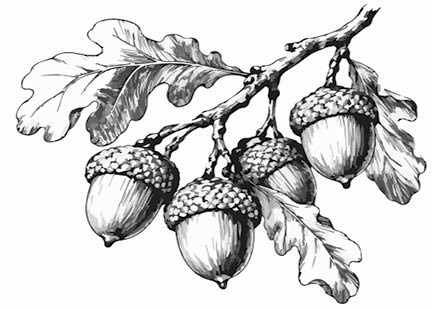
By Janice Baronian
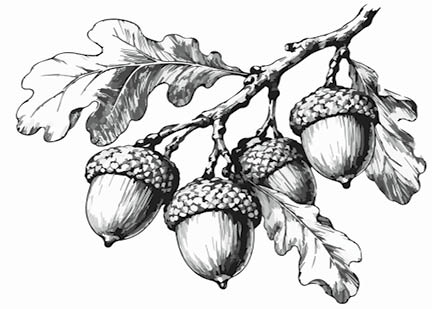
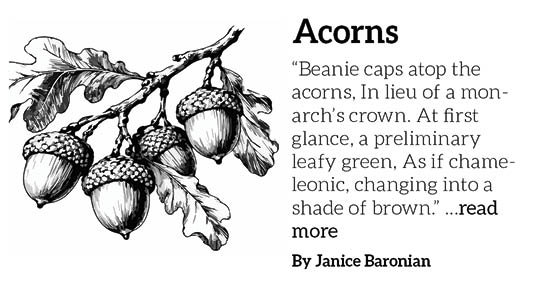
Beanie caps atop the acorns,
In lieu of a monarch’s crown.
At first glance, a preliminary leafy green,
As if chameleonic, changing into a shade of brown.
Startled, a passerby gets conked on the noggin
As he looks up at the gray-fringed clouds in the sky.
Seeing naught save for a flock of geese
In a V formation
As they continue to fly.
No parachutes—the acorns continue to “fall”
Into the colorful “autumn” leaves accumulating on the ground.
Bushy-tailed squirrels gather the nuts,
In their pouch-like cheeks,
As many as can be found.
Blue jays come crying out, “Thief! Thief!”
As the rodents attempt to bury their find
’Neath the wood chips in the earth
For winter’s stash.
Grandma runs to the veranda to see what the ruckus is all about,
Taking her broom, trying to shoo the birds away,
Along with the ghost of Jimmy Durante’s Mrs. Calabash.


















By Tonie Ann White
“Dad, can’t I please have a cat?” It was the ear-ly 1960s, and I was asking for a barn cat. It would never see the inside of our house. There would be no vet visits or shots, and certainly no litter box. Well, finally my fa-ther gave me the OK.
We were visiting my uncle, who managed a dairy farm in Simsbury. My uncle said, “Come with me, Tonie Ann. We’ll find a cat in the barn for you.” Well, he did find a cat—a pregnant cat! Looking back more than 60 years later, I think that was a sly joke on my father, who was the youngest of six brothers.
Mommy Cat was happy on our farm. She had a big, old barn to live in, with no end of birds and fields full of mice and chipmunks. We were happy to have her protecting our 100-pound bags of corn for our Angus steers and the yum-my-smelling molasses feed for our horses. She naturally put herself on surveillance duty in our grain room. I would find her there or in the hay-mow and give her love and attention between my barn chores.
Eventually, Mom-my Cat had her kittens up in the haymow. There is something so, so pleasant about finding new kittens in sweet-smelling hay. One looked identical to her, black with a hint of white on her chest. Another was brindle and looked like a teddy bear, hence the name Teddy. Dolly had long black hair, a white bib, and white fur framing her adorable pink nose. Dolly was adorable. Well, she was adorable until her long barnyard hair got matted and she had to have a GI hair-cut.
One day, Dad asked me to get a steel stake for a project he was working on. The stake was being used to hold a trap at the opening of a woodchuck hole down the hill from our house. What I saw was a sight of horror. Mommy Cat, never making a sound, was lying there with one broken leg caught in the trap. I ran crying to my family, and they came to her rescue. Well, res-cue in that they thought she should be put out of her misery. This was a farm, remember. I was working in tobacco, making 75 cents an hour, so I pledged to pay the vet bill myself.
So off Mom and I went to Doc Boardman in Westfield. Mommy Cat had her leg amputat-ed at the knee. Do cats have knees? When we brought her home, she had three legs and half of another. She was still her gentle, quiet self, and she lovingly went back to tending her three kittens.
What we witnessed next was truly amazing. Our barn was a huge, ancient peg-and-beam structure. The main beams were wide, flat, and solid, but the crosspieces left over from when our barn had been used for tobacco were non-structural, round poles, clearly having once been trees. I don’t know how tobacco workers balanced themselves while walking on those rounded surfaces, bending down to grab laths full of green leaves and carefully spacing them for drying. That was dangerous business.
Well, three-legged Mommy Cat also mas-tered those poles, high up in the barn, where she hunted birds and taught her three little kit-tens to do the same. Mommy Cat had a good, long life on our farm.
Mommy Cat






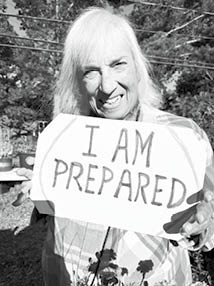
A fresh, bright start for me occurred when I was a Boy Scout with Troop 37 in Chicopee. “Be prepared” was instilled in us by the guys who took the Scout motto seriously. To this day, in my older years, my heart still beats the drum of readiness. Like you, I face challenges in life, and finding the right variety of tools to meet them can lead to success.
Life has different seasons, each with its own purpose and timing. Even the extensive pages of the Bible reminds us there is “a time to be born, and a time to die; a time to plant, and a time to pluck up that which is planted.” Every experi-ence, whether joyful or challenging, can offer les-sons that contribute to our growth.
Every day, we encounter personal challenges that require a response, ei-ther positive or negative. For example, in my role as care-giver for my wife, Susanna, who has Parkinson’s dis-ease, I sometimes become physically tired and men-tally worn down. I need to restore my strength and fill my mind with love’s endur-ance. I believe I have been given a wonderful gift in Susanna, along with the opportunity to care for her.
Recently, I had the privilege of talking with my trusted friend David. He said it was like I had been employed aboard a luxurious cruise ship! My responsibilities were extensive. I was expect-ed to select meals for my precious guest, keep ev-erything clean, and provide entertainment suited to her needs. I had to remain alert, making certain comfort and joy surrounded every encounter.
As David continued his creative story, I real-ized my mindset needed an adjustment. Like a compass pointing north, my attitude returned to “I can and must do this.” His story reminded me that being prepared involves more than having the right physical tools. We must also prepare our hearts and minds.
David’s story recalled another passage I had recently read. Are you a puddle or a pipeline? When water collects in a puddle, it may become stagnant because it has nowhere to go. A pipe-line, on the other hand, carries water where it is needed. What a wonderful picture of how we can serve others! The kindness and encouragement we receive can flow through us for the benefit of someone else.
Sometimes being prepared means accepting a change in plans and discovering something worthwhile in the experience. During the late summer, Hampton Ponds’ swimming beaches were closed because of a cyanobacteria bloom. Swimming was restricted, and the usual water activity was absent.
Susanna and I enjoyed the peaceful views, rarely experienced during the busy summer season. We learned to be content with what was available to us. Simply sitting still and observing the wildlife provided an opportunity to appreci-ate nature in a different way.
Looking back in life’s rearview mirror, we may recognize how our experiences have instructed us. Trials, along with love and kindness, can strengthen us, much as a tree develops growth rings through the changing seasons. A timely word, spoken at just the right moment to meet a particular need, can make a tremendous differ-ence.
We can also work to avoid gossip, unneces-sary criticism, and hurtful remarks. There is little profit in words that cause harm when we have opportunities to offer encouragement instead.
Finally, my fellow readers, strive for restora-tion. Invigorate one another, maintain a sound mind, and live in peace. Enjoy the rewarding mo-ments life offers, and remember that each new season gives us another opportunity to grow.
Be prepared to offer kindness, encouragement, and a helping hand whenever the opportunity arises.
Susanna and I are always ready to cheer you on!











Back to Index
Back to Index
Back to Index
Back to Index
Back to Index


How to get
rid of Guilt

Everywhere I go, I meet people who are punishing themselves for their past. They play a game called “If only.” If only I had listened. If only I knew then what I know now. If only I could erase that mistake and start over.
Everybody has regrets. We all say foolish things, make poor decisions, hurt people we love, and wish we had taken a different road. But here’s the point: God wants us to learn from our mistakes. He never intended for us to spend the rest of our lives imprisoned by them.
So, what do we do with regret? I want to look at two things: what God does with our regrets and what we should do with them. God’s part, and our part.
First, God forgives completely. Go to God with your regrets. This very day, this very hour, tell Him the whole story. Don’t hold anything back. Isaiah 1:18 offers this promise: “Though your sins are like scarlet, they shall be as white as snow.”
There isn’t a detergent in the world that can make that claim! God is not looking for another opportunity to remind you of your failures. He wants to clean your conscience and give you the freedom to move ahead.
When Jesus died on the cross, He said, “It is finished!” (John 19:30). Christians understand those words as the completion of His sacrifice for our sins. Think about a bill you worried over last winter. Maybe it kept you up at night. But once that bill was paid, did you keep sending money? Of course not. The debt had been set-tled.
That is the assurance God offers through Christ. He doesn’t want you living as though the bill is still coming due. Learn what the past can teach you, certainly. But don’t keep paying for the same mistake with every day of your fu-ture.
Second, God forgives instantly. Have you noticed how people sometimes handle forgive-ness? We make someone wait. We want an-other apology, another explanation, maybe a little more suffering. But God does not put us through an obstacle course before offering His mercy.
Romans 8:1 tells us, “There is now no con-demnation for those who are in Christ Jesus.” Notice that word: now. Not someday. Not after you’ve spent years making yourself miserable. Now.
Remember the Etch A Sketch toy? You turned the knobs, drew your picture, and sometimes made a terrible mess. Then you turned it over, gave it a shake, and had a clean screen. That’s a picture of a fresh start. You can stop staring at yesterday’s lines and begin drawing something new. The mistake was real, but it didn’t have to be the last thing you ever drew.
Third, God forgives eternally. God promises in Hebrews 8:12 that He will remember our sins no more. That doesn’t mean an all-knowing God suddenly loses His memory. It means He chooses not to hold forgiven sins against us.
Some of you have been carrying guilt for years. You picture yourself standing before God, trying to explain what happened, searching for words that might excuse it. But His promise of forgiveness is not temporary. He isn’t waiting to pull an old mistake out of a drawer and wave it in your face.
God forgives completely, instantly, and eter-nally. That’s His part. Now, what about ours?
First, accept forgiveness. Why is it that when we feel guilty, we often run away from God in-stead of toward Him? Jesus said He came not to condemn the world but to save it (John 3:17). If you are burdened by regret, let Him love you. Stop turning your back on the very One offering to help you.
The Bible says, “Everyone who calls on the name of the Lord will be saved” (Romans 10:13). That invitation includes you. You do not have to find the perfect words or pretend your past was perfect. Just come to Him honestly and ask for a new beginning.
Second, don’t be too hard on yourself. Maybe you’re saying, “Jeff, I believe God forgives me, but I just can’t forgive myself.” I understand that feeling. Sometimes we are far harsher with ourselves than we would ever be with a friend.
But think about what you’re doing. If God has offered forgiveness, why keep handing yourself the same punishment? Are you going to hold yourself to a standard that leaves no room for the grace you gladly extend to someone else?
Perhaps something in your past still embar-rasses you. Who are we to criticize? We’ve made mistakes, too. And before judging another per-son, we ought to consider what we might have done if we had walked in that person’s shoes.
Accepting forgiveness doesn’t mean pretend-ing nobody was hurt or that nothing needs to be made right. Make the apology, repair what you can, and learn the lesson. Then allow your-self to keep living. There is a difference between taking responsibility for a mistake and deciding that the mistake is all you will ever be.
Third, start moving in the right direction. You may be thinking, “I’ve made so many bad choices. I’ve wasted so many years.” Listen to me: No matter where you have been, God can bless the rest of your journey.
Romans 8:28 reminds us that God works for good in the lives of those who love Him. It does not say that every mistake is good. It says that even from our failures, something worthwhile can grow. It’s not just where you’ve been that matters. It’s where you’re headed. One good de-cision today may not undo every wrong turn, but it can point you toward a very different to-morrow.
Let me close with a story.
On New Year’s Day in 1929, the University of California played Georgia Tech in the Rose Bowl. During the second quarter, California’s Roy Riegels recovered a fumble, got turned around, and ran more than 60 yards in the wrong direction. His teammate Benny Lom caught up with him near California’s goal line. Shortly afterward, Georgia Tech scored a safety.
Imagine how Riegels felt. In the locker room at halftime, he was devastated. As the story has often been told, Coach Nibs Price announced that the same team would start the second half. The other players stood up, but Riegels stayed where he was.
He told his coach that he couldn’t face the crowd. He believed he had let everyone down.
Price put a hand on his shoulder and encour-aged him to return. His message was simple: “The game is only half over.”
Riegels went back onto the field and played a strong second half. His mistake did not disap-pear, but neither did it have the final word. He could not change the first half. What he could change was how he played the second.
Maybe you, too, have run in the wrong direc-tion. We all lose our bearings from time to time. We stumble, we fall, and sometimes we feel like quitting.
But God comes alongside us and says, “Get up. Get back in the game. The game is only half over.”
And who knows? Your best half may still be ahead.





10-5



Stanley Park
Garden Workshop
Tuesday Oct 27th — “Fall Bulb Planting and How to Prep Your Gardens for Winter” The Stanley Park Greenhouse & Horticultural Staff will lead a workshop on fall bulb planting and how to prep your home gardens for the winter from 10am to 11am. If time allows, we will take a walk to other garden(s).
The workshops will meet at the fountain in the Rose Garden. Please use Gates 2 or 3 for parking and easy access to the Rose Garden.
For further information on the Garden Workshop, please go to www.stanleypark.org or call the park office at 413-568-9312.

To include your event, please send information by the 1st of the month. We will print as many listings as space allows. Our usual publication date is around the 15th of the month. Email to: magazine@southwoods.info.
Southwick High School
Class of 1976 50th Reunion
Saturday, November 7th 1pm-5pm - The Southwick High Class of 1976 will be holding its 50th reunion Saturday, November 7th 1pm-5pm at the Brass Rail Meeting House. Price is $50 per person. RSVP by October 1st. Call or text 413-478-0653 for more information. Payable by cash, check, or Venmo. Join your classmates for a nice dinner, socializing, and live entertainment!


Friends of the Southwick Public Library
Holiday Basket & Gift Card Raffle (Request-ing Raffle Donations)
November 9-16th — The Friends of the Southwick Public Library are seeking donations of Gift Baskets and Gift Cards from local businesses to be displayed in the Library from November 19th through December 9th. Raffle tickets will be available for purchase during this time.
Individuals, groups, clubs and businesses are invited to contribute a Gift Basket or donate a Gift Card. This is a great way to highlight your business and demonstrate community support. Finished baskets and gift cards may be dropped off at the Library November 9-16. *Please note - NO alcohol is allowed in any gift basket. However, a gift card to a local package store may be included.
The Holiday Raffle drawing will be held during a Hot Chocolate Bar event at the Library on December 9th at 5:30PM. You need not be present to win.
Proceeds from this raffle provide funding for enrichment programs and resources that are not in the Library’s general budget. We are grateful for your support!
Southwick Regional School National Honor Society
Holiday Giving Tree
Tuesday, November 10th — The National Honor Society at Southwick Regional School is once again organizing its annual Holiday Giving Tree, helping make the holiday season brighter for children and families in the school community.
The program provides assistance to district families who may need a little extra support during the holidays. Families may request clothing, winter necessities, one pair of shoes per child, and up to three age-appropriate gift suggestions for each child. Gifts are provided through the generosity of local families, school staff, community members, and organizations.
New this year, families requesting assistance must obtain a Family Assistance Request Form by contacting Maryanne Margiotta at mmargiotta@stgrsd.org. Completed forms must be returned no later than Tuesday, November 10, 2026. Simply requesting a form by that date is not sufficient. Families are encouraged to apply early to allow time for donations to be coordinated.
While every effort will be made to fulfill requests, specific gifts cannot be guaranteed. Gift cards, electronics, gaming systems, and other high-cost items cannot be provided. All family information and participation will remain strictly confidential.
Community members interested in helping are warmly encouraged to participate. Those wishing to purchase gifts or sponsor a participating family can contact Maryanne Margiotta for information about donation opportunities.
Every contribution, large or small, helps spread kindness and holiday cheer throughout the Southwick Regional School community.
For assistance, donations, or additional information, contact Maryanne Margiotta at mmargiot-ta@stgrsd.org.
Southwick Rotary and Interact Club
Community Lending Library
Southwick Rotary and Interact, the high school version of Rotary, have joined forces to create a new lending library at the Southwick Congregational Church, located at the corner of Depot Street and College Highway in Southwick.
The Interact Club, which has been in existence for more than 20 years, undertakes a public service project each year. This year’s project was the creation of a lending library to serve the greater Southwick community, reflecting Rotary’s motto, ”Service Above Self.”
Amy Pomeroy, Southwick High School teacher and Interact advisor, helped students organize the project. The school’s woodshop teacher assisted students in building the library, while Mike Parent, Rotary advisor to Interact, helped complete the project during the summer months.
Several local businesses and organizations contributed to the effort. Haste Fence provided the base, Southwick Congregational Church offered the location, Atrium Property Services added enhancements, and Southwoods Printing and Signs contributed the exterior lettering.
The lending library is already stocked with books for both children and adults.
Rotary is pleased to support high school students in serving their community, and the Interact Club thanks everyone who helped bring the project to completion.
Community members are invited to participate in the “Give and Take” of the new lending library, sharing books and discovering new ones to enjoy.
Southwick Historical Society, Inc.
A Walk With Southwick Spirits
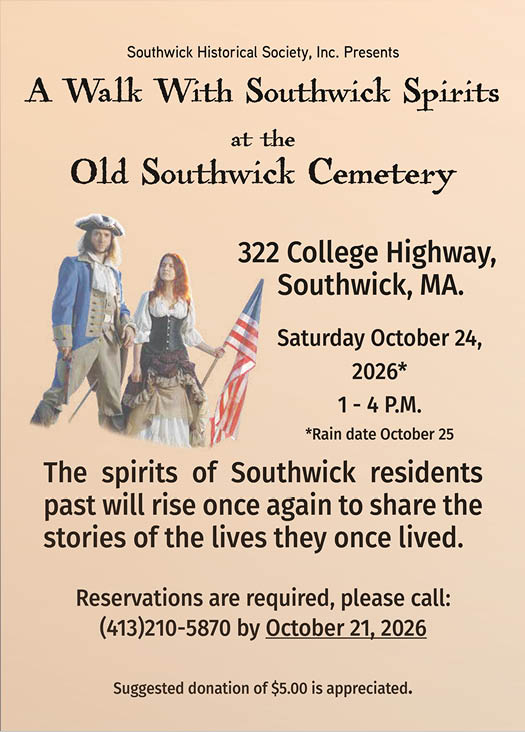
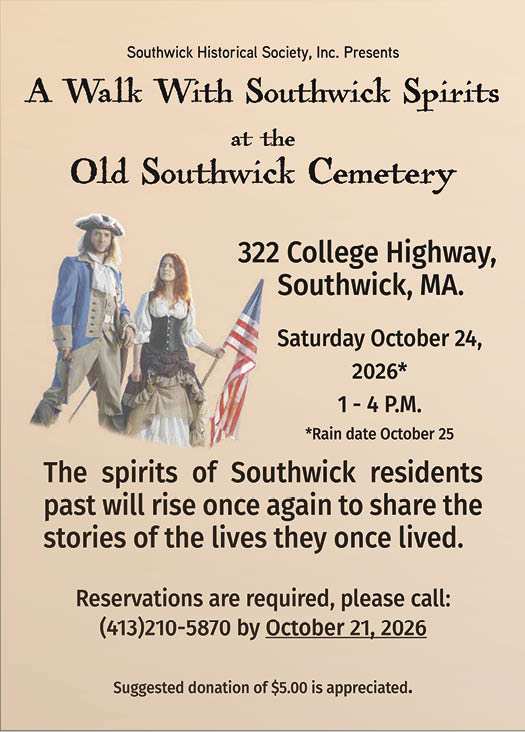
Saturday, October 24 — The Southwick Historical Society, Inc. invites the community to take a journey into the town’s past with ”A Walk With Southwick Spirits” on Saturday, October 24, 2026, from 1 to 4 p.m. at the Old Southwick Cemetery, 322 College Highway in Southwick.
Set among the historic gravestones of the Old Southwick Cemetery, the event offers an engaging way to connect with the community’s heritage and gain a greater appreciation for those who came before us.
Presented by the Southwick Historical Society, the afternoon promises a blend of history, storytelling, and a touch of seasonal spirit. It’s an opportunity to experience local history in a setting where the past feels especially close.
Reservations are required and must be made by October 21, 2026. To reserve a place, call (413) 210-5870.
A suggested donation of $5 per person is appreciated to support the event. The rain date is Sunday, October 25.
Come walk among Southwick’s spirits and hear the stories of residents whose lives helped shape the town we know today.
Jam Session
Join us for Jam Sessions every Thursday from 6pm-9pm in the Southwick Meeting House located at 222 College Highway (formerly Christ Methodist Church). For more info please call Bob Fox at 413-579-4585. Open to all and any age. All fun and no pressure. Explore your talent or come to listen to some good music.
Southwick Library
Books on the Go
Southwick residents who are unable to visit the library in person can take advantage of Books on the Go, a free service that provides library materials to eligible residents.
The program is available to any Southwick resident who is unable to visit the library in person and needs access to library materials.
To receive Books on the Go delivery, participants must be Southwick residents with a CWMARS library card in good standing or meet the eligibility requirements to obtain one.
The service is offered free of charge, helping ensure that residents who cannot visit the library in person can still receive library materials. For more information about Books on the Go and eligibility requirements, call 413-569-1221.



COUNTRY PEDDLER
CLASSIFIEDS


PRAYER OFFERINGS
DELREO HOME IMPROVEMENT for all your exterior home improvement needs, ROOFING, SIDING, WINDOWS, DOORS, DECKS & GUTTERS extensive references, fully licensed & insured in MA & CT. Call Gary Delcamp 413-569-3733
RECORDS WANTED BY COLLECTOR - Rock & Roll, Country, Jazz of the 50’s and 60’s All speeds. Sorry - no classical, showtunes, polkas or pop. Fair prices paid. No quantity too small or too large. Gerry 860-402-6834 or G.Crane@cox.net
Lakeside Property management - For all your landscaping needs. Mowing, new lawn installs, sod, mulch/stone installation, bush trimming, retaining walls, snow plowing/removal, etc. Serving Southwick, Suffield, Granby, Agawam, Westfield, Simsbury. Residential and commercial. Call Joe 413-885-8376. Give us a to get that property looking the way you want it! Now accepting major credit cards.
The granby motel- 551 Salmon Brook Street Granby, CT 06035. Room for rent, weekly, daily, & monthly. Wifi available. Stove, Refrigerator, Kitchen. LONG TERM RENTAL AVAILABLE AT AFFORDABLE PRICE. Ask for Mike Shaw. 860-653-2553
St. Jude’s Novena - May the sacred heart of Jesus be adored, glorified, loved and preserved throughout the world now, and forever. Sacred Heart of Jesus pray for us. St. Jude, Worker of Miracles, pray for us. St. Jude, Helper of the Hopeless, pray for us. Say this prayer 9 times a day. By the 8th day your prayer will be answered. It has never been known to fail. Publication must be promised. Thank you St. Jude. ..- GR






GOODS & SERVICES

GOODS & SERVICES

Back to Index
Back to Index
Back to Index